Erg Chigaga weather: Foum Zguid figures month by month, camp nights and wind
In short: a hot desert. In Foum Zguid the July afternoon reaches 41 °C and the January one 18.5 °C; nights sit between 6 °C in winter and 25 °C in summer. Rain: roughly ten days a year, 50 to 60 mm in total. In Erg Chigaga, summer afternoons hover at 40 to 44 °C as a rule and 45 to 47 °C in a heat wave, while a clear January night at camp falls to between 0 and 6 °C. No official station exists out here, so our tables use the Open-Meteo ERA5 model, averaged over 1991-2020, set against what we see for ourselves on the ground.
This fact sheet describes the weather itself. To choose the dates of your trip, read our page on the best season for the Moroccan Sahara instead.
Foum Zguid: the village climate, month by month
| Month | Low °C | High °C | Records low / high °C | Humidity | Rain mm | Days of rain |
|---|---|---|---|---|---|---|
| January | 5.6 | 18.5 | -2.0 / 28.9 | 39% | 3.8 | 1.0 |
| February | 7.7 | 20.8 | -1.3 / 29.6 | 36% | 9.6 | 1.6 |
| March | 11.0 | 24.9 | 2.1 / 34.7 | 29% | 6.9 | 1.3 |
| April | 14.5 | 29.1 | 6.0 / 37.9 | 25% | 2.1 | 0.2 |
| May | 18.1 | 33.0 | 8.1 / 40.5 | 22% | 1.3 | 0.4 |
| June | 21.8 | 37.6 | 13.7 / 43.7 | 19% | 1.2 | 0.2 |
| July | 25.0 | 41.4 | 18.3 / 45.5 | 14% | 0.4 | 0.0 |
| August | 24.9 | 40.3 | 16.7 / 45.0 | 18% | 1.7 | 0.4 |
| September | 20.9 | 35.4 | 13.2 / 41.6 | 25% | 4.9 | 0.9 |
| October | 16.3 | 29.2 | 7.0 / 38.0 | 33% | 13.8 | 1.5 |
| November | 10.7 | 23.0 | 2.5 / 32.4 | 39% | 7.7 | 1.0 |
| December | 7.0 | 18.9 | -0.6 / 27.1 | 46% | 6.4 | 1.2 |
| Whole year | 60 | 9.7 |
- Definitions: a day of rain means 1 mm or more; humidity is the average over the whole day.
- Model records: heat, 45.5 °C on 30 July 2023; cold, -2.0 °C on 9 January 1993.
- Village altitude: about 700 m.
- The pattern: mild winter days and cool winter nights, very hot summers, dry air (average humidity 46% in December, 14% in July). Rain comes down to a handful of showers, October first, then February.
Erg Chigaga temperatures and Lake Iriqui: one to three degrees warmer
- Why warmer: the dunes and the Iriqui basin lie below the village. Their model cell stands at 457 m, the Foum Zguid cell at 651 m. The gap, one to three degrees, shows most at night and in summer.
- What the table covers: the model cell over the Iriqui basin, on the western side of the erg (spelled Erg Chegaga on some maps). Swap it for a neighbouring cell further into the sand and the difference stays under 0.3 °C.
| Month | Low °C | High °C | Records low / high °C | Gusts km/h | Rain mm | Days of rain |
|---|---|---|---|---|---|---|
| January | 7.2 | 19.3 | 0.0 / 29.1 | 29.9 | 2.6 | 0.7 |
| February | 9.3 | 22.0 | 0.5 / 31.6 | 34.1 | 7.9 | 1.3 |
| March | 12.7 | 26.3 | 3.6 / 36.4 | 38.5 | 4.5 | 0.9 |
| April | 16.4 | 30.6 | 8.2 / 40.9 | 43.1 | 1.7 | 0.3 |
| May | 20.0 | 34.6 | 9.1 / 43.3 | 43.2 | 1.5 | 0.4 |
| June | 24.0 | 39.2 | 15.7 / 45.3 | 41.0 | 0.9 | 0.2 |
| July | 27.7 | 43.1 | 20.1 / 47.5 | 38.7 | 0.2 | 0.0 |
| August | 27.5 | 42.0 | 19.2 / 47.3 | 37.7 | 0.9 | 0.3 |
| September | 23.5 | 37.0 | 14.2 / 43.9 | 38.8 | 4.5 | 0.7 |
| October | 18.5 | 30.7 | 9.1 / 40.3 | 34.5 | 10.7 | 1.2 |
| November | 12.5 | 24.3 | 3.3 / 34.8 | 31.0 | 5.2 | 0.8 |
| December | 8.3 | 19.8 | 1.3 / 29.9 | 29.1 | 4.9 | 1.0 |
| Whole year | 45 | 7.9 |
- Lake Iriqui: this same table applies to it. The next cell, closer to the sand, gets about 52 mm of rain yearly, with a cold record of -0.4 °C, set on 9 January 1993.
- Gap between day and night: 11.5 °C in December, up to 15.5 °C in July.
- Gusts: for each month, the mean of the strongest gust of every day, measured ten metres up.
- Heat record: 15 July 2024, at 47.5 °C.
Where the figures come from: a model, not a station
- No official station: none at Foum Zguid, none at Erg Chigaga, none at Lake Iriqui. The closest reference station with published normals is Ouarzazate, 160 km away by road (2.5 h).
- So, models: every table published online for these places, ours too. Here, the ERA5 reanalysis provided by Open-Meteo, averaged from 1991 to 2020.
- Our check: we set the model against the Ouarzazate station. July mean high: 36.9 °C in the model, 38.8 °C measured. Rain over a year: 95 mm in the model, 115 mm at the station.
- What follows: the tables err on the cautious side. Real summer afternoons are likely 2 to 3 °C hotter, and rain slightly heavier. Hence the 40 to 44 °C we give for July.
- Sunshine: here the models overshoot, so we quote stations only: roughly 3,300 to 3,500 sunny hours per year (Ouarzazate 3,467 h, Errachidia 3,322 h, 1981-2010 normals).
Camp nights: colder than the model
It is the question we hear most. Each model cell spans 10 to 25 km, far too coarse to see the sand losing its heat under a clear sky. On the lakebed and between dunes, nights often turn colder than the table shows. Nobody logs temperatures at the camp, but that is where we spend our nights.
| Period | Night temperatures | What it means |
|---|---|---|
| December to February | Model: 7 to 9 °C as the average low. Camp, clear night without wind: January 0 to 6 °C, December 3 to 8 °C | 0 °C is an extreme, not the norm. |
| March, April, October, November | Model: 12 to 19 °C as the average low | A fleece, nothing more. |
| June to August | Model: 24 to 28 °C as the average low | Too warm for good sleep in the dunes, which is why our desert camp runs only from September to early June. |
Against Merzouga: winter nights are colder there (a January average low of 3.6 °C, against 7.2 °C at Erg Chigaga; model record -5.6 °C), and the spring wind blows harder. The other differences are listed on the Erg Chigaga vs Erg Chebbi page.
September 2024: the storm that filled the lake
- In a normal year: very little rain, 45 mm at the foot of the erg and 60 mm in the village. That average masks rare and very violent storms.
- 7 and 8 September 2024: an extratropical low crossed the north-west of the Sahara. NASA's satellite estimates went from a few tens of millimetres to over 200 mm, close to one year of rain.
- According to the Moroccan government: in those two days several areas, Tata among them, went past their yearly average; at Tagounite, in the Draa valley, over 100 mm fell within 24 hours.
- According to the model, Iriqui basin: 7 September, 61 mm; 8 September, 35 mm; the month as a whole, 137 mm, or roughly three years of rain.
- The toll: at least 28 deaths in Morocco, the authorities said.
- The lake: NASA released two satellite images, dated 14 August and 10 September 2024. On the second one, water covers the lakebed inside Iriqui National Park. It did not stay: by 2025-2026 the lake had gone back to a flat of dry clay.
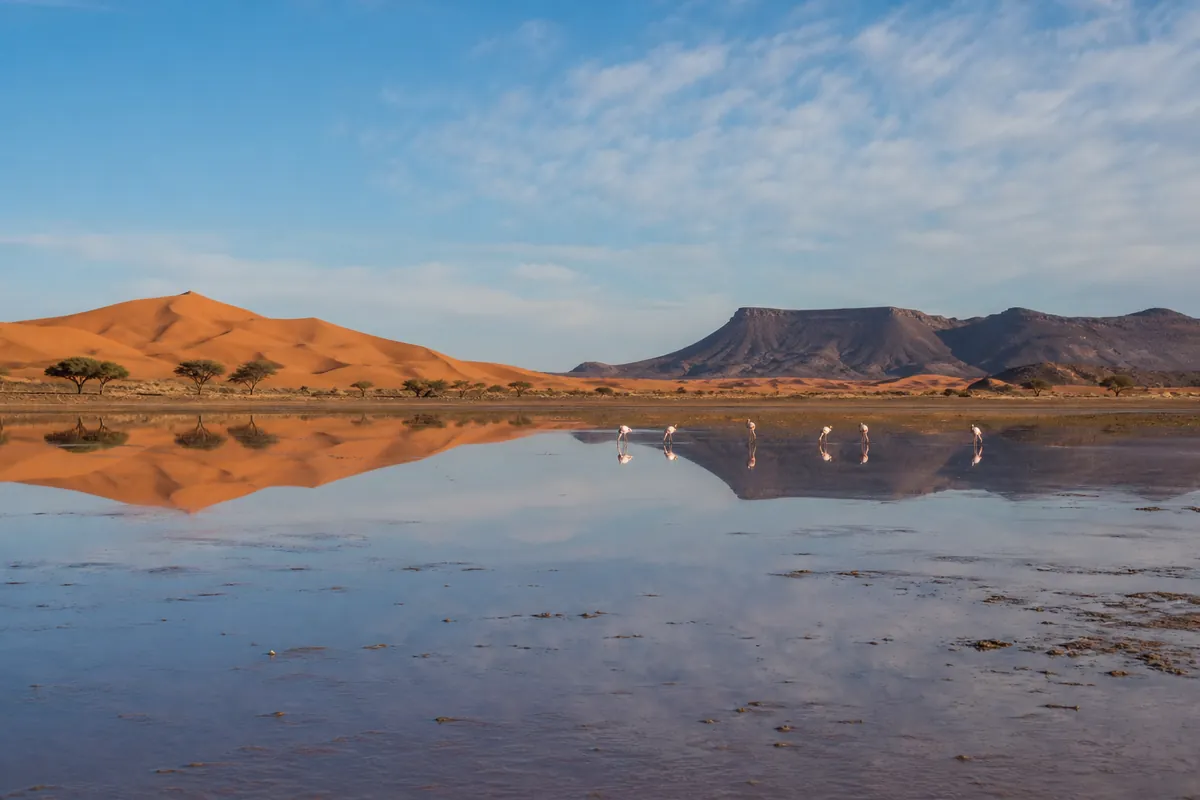
Nothing new, though. The model holds similar episodes. Foum Zguid, 22 November 2014: 50.3 mm. Iriqui basin, 22 October 2003: 68.8 mm. A big storm of this kind returns in autumn roughly once every ten years.
Chergui and sand wind: two different things
- A frequent mistake: saying the chergui blows in spring. We have written it ourselves; it is a shortcut.
- The chergui: a wind from the east or south-east, hot and very dry, its humidity almost always below 15%. It blows most often in July and August. The north and west of the country feel it most, as a heat wave.
- The sand wind: a spring wind, hot or not, that lifts sand off the dunes. In the model, the strongest gust of the day peaks in spring (on average 43 km/h in April and May for the cell in the table), against roughly 30 km/h in December and in January.
- Dust haze: more frequent from the end of spring into summer.
- Calmest months: November to January.
Sunrise and sunset times, GMT
Since 20 September 2026 Morocco has kept GMT all year round, Ramadan included. Any page written before that date in the old time (GMT+1) is therefore an hour out.
| Date | Day length | Erg Chigaga (sunrise / sunset) | Foum Zguid (sunrise / sunset) |
|---|---|---|---|
| 15 October | 11.5 h | 06:27 / 17:57 | 06:28 / 17:58 |
| 15 November | 10.7 h | 06:51 / 17:31 | 06:52 / 17:32 |
| 21 December | 10.1 to 10.2 h | 07:17 / 17:31 | 07:19 / 17:32 |
| 15 January | 10.3 to 10.4 h | 07:22 / 17:47 | 07:24 / 17:48 |
| 15 February | 11.1 h | 07:07 / 18:14 | 07:08 / 18:15 |
| 20 March | 12.1 h | 06:32 / 18:37 | 06:33 / 18:38 |
| 15 April | 12.9 h | 06:00 / 18:52 | 06:02 / 18:54 |
| 15 May | 13.6 to 13.7 h | 05:33 / 19:11 | 05:34 / 19:13 |
| 21 June | 14.1 to 14.2 h | 05:26 / 19:29 | 05:26 / 19:31 |
| 15 July | 13.9 to 14 h | 05:35 / 19:29 | 05:36 / 19:31 |
| 15 August | 13.3 h | 05:53 / 19:09 | 05:54 / 19:10 |
| 15 September | 12.4 h | 06:10 / 18:33 | 06:11 / 18:34 |
- In December: to watch the sun go down from a ridge, be at camp before 17:30.
- In summer: sunrise comes between 05:26 and 05:54. The lake is 1 h of track from the village, so being there at first light means setting off in the dark. Say so when you book a summer Lake Iriqui day trip.
What to pack, season by season
Depending on month and place, the night averages 11.5 to 16.4 °C cooler than the afternoon. At camp, beds and blankets are provided. Full list: our desert packing list. The short version:
| Period | What to bring |
|---|---|
| June to September | Lip balm (humidity falls to 13 or 14%), plenty of water, a hat with a wide brim, long and loose clothes. |
| October and November | Summer clothes for the day, a jumper for the evening, a thin windproof layer in case of a storm. |
| December to February | For the night: a woolly hat, thick socks, a down jacket or a heavy fleece. For the afternoon (19 to 22 °C): one light layer. |
| March to May | A cheche or a scarf, wraparound glasses against the sand, sun cream, a fleece for the evening. |
Weather apps: their three blind spots
We do not publish a live forecast. For today's temperature or the 5-day outlook in Foum Zguid, an app is enough, with three caveats in the desert:
- The place: the app computes a grid point centred on the village, not on the camp. Out in the dunes, the afternoon runs one or two degrees warmer; under a clear sky, the night drops several degrees below the forecast minimum.
- The name: some services, meteoblue for example, do not know "Chigaga". You have to pick M'hamid or Tissint, bearing in mind that M'hamid lies on the opposite side of the erg.
- The bias: as the Ouarzazate comparison shows, models stay slightly too cool on summer peaks and slightly too dry on rain.
The most reliable option: message us the day before, and we read the forecast together with the state of the tracks. To sleep in the dunes, there is our Foum Zguid to Erg Chigaga tour over 2 days. With a single day, the Erg Chigaga day trip. To place the erg on a map, open our Erg Chigaga page.
Questions and answers
What temperatures can Erg Chigaga reach?
In a heat wave, 45 to 47 °C. On an ordinary July afternoon, 40 to 44 °C in practice, while the model gives a 43 °C average. Record in the model for the Iriqui basin: 47.5 °C, set on 15 July 2024. July humidity sits near 13%.
Do nights get cold in Erg Chigaga?
In winter, yes, from December to February. At camp under a clear sky, January nights usually bring 0 to 6 °C, colder than the 7 to 9 °C average low that the model shows. Frost is rare here: the coldest value in the model is close to 0 °C (7 January 2000).
Erg Chigaga in March, April or November: what weather should I expect?
November: 24 °C in the afternoon, 12 to 13 °C after dark, light wind, roughly 5 mm of rain over the whole month. March: around 26 °C, then 13 °C at night. April: 31 °C by day, 16 °C by night, plus the strongest wind of the year, the top gust of an average day reaching 43 km/h.
What weather does Foum Zguid get in July?
Very hot and very dry: 41.4 °C on an average afternoon, 25 °C at night, humidity at 14% and rain close to zero. Our dune camp is open from September to early June. For the hot months, we propose sunrise at Lake Iriqui followed by a night spent in the village.
Which months bring rain to Foum Zguid?
October above all (13.8 mm on average), ahead of February (9.6 mm). From June to August it hardly rains. Year total: around 50 to 60 mm, falling on some ten days. One storm can still beat that total on its own, which is what happened in September 2024.
How do I check the forecast for Erg Chigaga?
Start with any weather app set to Foum Zguid: its forecast holds for the village. Out in the dunes, count on slightly more warmth after midday and a few degrees less at night. Then, on the eve of your departure, send us a WhatsApp message and we will tell you what the sky is really doing out there.