Your bag for the desert: the full list, season by season
In short: your bag for the desert will be lighter than planned, and your evenings cooler than you imagine. Take a soft holdall rather than a rigid case, three layers for after dark, solid sun protection and a head torch. Below is the list we send travellers before each departure, adjusted to the season, with what can stay at home.
In the bag, whatever the season
- Head torch, with new batteries. Lanterns light the camp, but to move around after dark you need a beam of your own.
- Factor 50 sun cream, even in winter: the sand throws light back at you all year round.
- Cheche or large scarf: it shields you from the sun by day, from blown sand and from the chill after sunset. Buy it locally.
- Soft bag of 40 to 60 litres. A rigid case fits badly in a 4x4 and cannot be strapped onto a camel.
- Sunglasses: category 3, held by a strap for windy dune climbs.
- Two pairs of shoes: closed, lightweight ones for the track, sandals for the sand. On the dunes, most people end up barefoot.
- Refillable bottle: we supply mineral water, and your own bottle stops small plastic ones flying off in the wind.
- Power bank: charging is possible at the camp, but the sockets are shared.
- Health kit: saline solution, blister plasters, your usual medicines. If you wear contact lenses, the sand will make them a nuisance.
For the evening: the extra layer by season
| Period | Add | Night at the camp |
|---|---|---|
| December to February | A light down jacket that packs small, a beanie, thin gloves, wool socks. Sleeping bags for the cold are on us: you mostly feel the chill during the evening round the fire. | 0-10 °C |
| March-April and October-November | Long trousers and a fleece are enough. | 10-19 °C |
| May and September | No warm clothes. Pack long sleeves against the sun instead, and twice as much water for the daytime. | 18-24 °C |
Full temperatures for every month are on our page about when to visit the Sahara. A few days before leaving, also look at our sheet on Erg Chigaga weather: rain, wind and nights at camp, month after month.
What can stay at home
- The umbrella and the hairdryer.
- City shoes and heels.
- Spare jeans: the pair you wear will do, and the dust gives it character.
- The heavy guidebook covering the whole country: three days in the dunes can do without it.
- A drone with no permit. In Morocco, flying one is regulated and bringing a drone into the country needs prior authorisation. Without it, the drone stays at customs, sometimes for good. Are you a photographer? Write to us before you leave: legal options exist, and they need preparing well ahead.
Trekking on foot: the extra rules
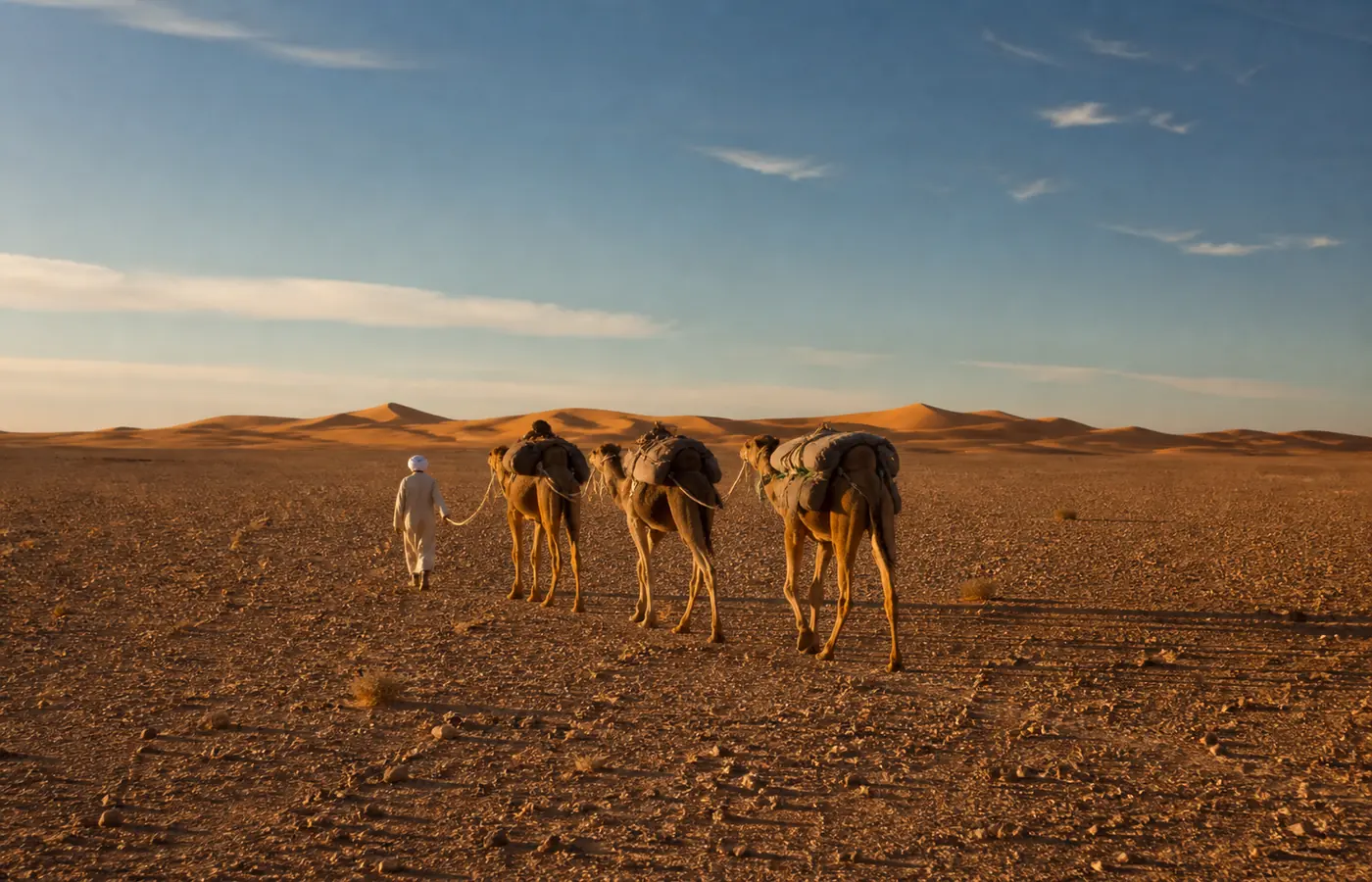
- Weight: 8 to 10 kg per bag, no more. The camels carry the luggage, but their load has a limit.
- Socks: a clean pair for each day of walking.
- Shoes: already worn and shaped to your feet. The desert is no place to break in new ones.
- Full list: our treks page has it, and each booking confirmation repeats it.
Questions and answers
Do I need to buy a cheche before I travel?
No need. Pick one up at the souk in Foum Zguid, or ask our guides, who also teach you how to tie it: a quarter of an hour does it, and the knack stays with you. It is a strip of light cotton, four or five metres long, in any colour you fancy. Out here nothing you own is more useful, and it makes a fine souvenir to take home.
Do women need to dress more modestly?
Not in the desert: at camp and on the track, shorts and a vest top are fine. In the village, as across rural Morocco, people appreciate it when shoulders and knees are covered. The real risk is the sun, and loose long sleeves in thin fabric beat any sun cream.
Can I charge my phone or wash clothes at the camp?
Charging, yes: the camp runs a solar battery, and the 4x4s have sockets. Washing clothes, no: out in the dunes, every litre of water goes to drinking. So pack one clean top per day, and accept that dust is part of the trip.