Quick facts
- Length
- 3 days / 2 nights
- Starting point
- Foum Zguid
- End point
- Foum Zguid
- Vehicle
- On foot with camels, back by 4x4
- Group size
- Up to 8 people
- Rate
- From €230 per person, based on 2 travellers
- Treks run
- October to April
- To book
- By WhatsApp or the form
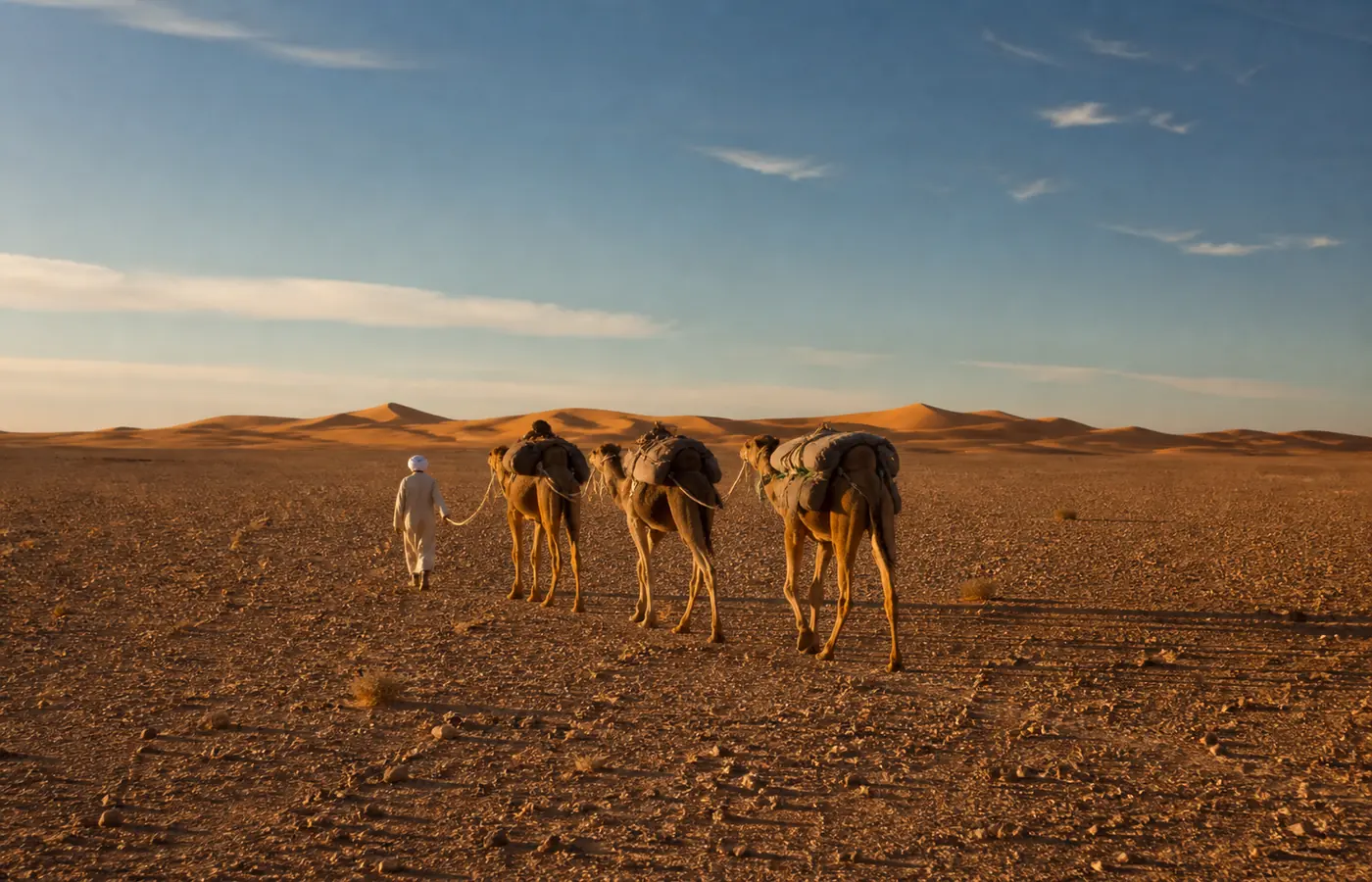
In short: a 3-day, 2-night camel trek from the Foum Zguid palm grove. Route: along Jbel Bani, the dunes of Erg El Mhazil, then the northern shore of Lake Iriqui. Mobile camp, pitched in a new spot each evening, and a 4x4 back at the end.
Pace: the camel's, roughly four kilometres an hour. Slow enough to see the country shift around you rather than pass through it. You learn to read the marks on the ground, you can number the acacias one by one, and no motor ever cuts into the quiet. For centuries this was how everyone travelled here, and nothing since has bettered it.
Team: a cameleer from the area, whose family has raised its animals for generations, and a cook who has camp ready by the time the sun sets. You walk with the caravan and climb onto a camel whenever you feel like it.
The essentials
- Three days on foot with a camel caravan
- Erg El Mhazil, then the shore of Lake Iriqui
- A mobile camp, pitched somewhere new each night
- A cameleer and a cook from Foum Zguid
- No vehicle and no engine noise on the way
- On foot or on a camel: you decide
The programme
Day 1
-
From the palm grove to the foot of Jbel Bani
Late morning: the animals are loaded and you walk out of the palm grove. South for about four hours, a meal break under an acacia, then a gentle slope up to the first camp, backed against the black mountain. In the evening the crests turn red, and dinner is by the fire.
Day 2
-
As far as the El Mhazil dunes
The finest stage: stony ground gives way to sand, and the erg shows itself wave after wave. Five to six hours on foot, with pauses and a long siesta while the sun is highest. Camp among the dunes, and a crest to climb for the starry night.
Day 3
-
The shore of Lake Iriqui, then the 4x4
An early start, before sunrise, so you reach the shore of Lake Iriqui while it is still cool; there the sand ends and white clay begins. Lunch, and then a 4x4 takes you back to Foum Zguid (2 h), sparing you the walk back.
In the price, and not
In the price
- One camel per traveller, plus the cameleer
- Cook and a complete mobile camp
- All meals, day-1 lunch through day-3 lunch
- Tent, mattress, blankets and a sleeping bag each
- Back by 4x4 from Lake Iriqui
- Tea and water whenever you want
Not in the price
- Other drinks
- Your own sleeping bag, if you prefer it
- Tips
On foot or on the camel: your call
People often imagine three days in the saddle. What actually happens is a mix. The camels walk at a person's speed, so most of the time it is easier to go on foot next to them; you ride on long flat stretches, late in the afternoon, or whenever your legs ask for a rest. There is no obligation either way, and no one keeps score of distances.
Effort: four to six hours of walking a day, on flat or barely sloping ground. No technical difficulty; by evening you are tired, the good kind of tired that brings deep sleep.
Mobile camp or fixed camp: the difference
The camels carry the whole camp: cooking pots, mattresses, rugs and light tents. Camp is pitched where the walking stops, often in the hollow of a dune the cameleer has picked because it breaks the wind. No shower, no electricity, no neighbours. For comfort: hot water in a basin in the evening, the light of an oil lamp, and the fire.
Compared with our Erg Chigaga camp it is basic, and that is the whole point: tonight you sleep on sand where nobody spent last night, and where nobody will spend tomorrow night.
When to go and weather
Period: October to April. Outside those months the walking gets too hard: above 35 °C the cameleers themselves refuse to leave, and rightly so. Best months: November and March, with days of 22 to 29 °C and nights that are easy to bear under canvas.
Questions and answers
Could we go all the way to Erg Chigaga by camel?
Yes, if you have the time: from Foum Zguid it takes 5 to 6 days on foot to get there, and you come back by 4x4. We put that crossing together on request, for groups free for long enough. In 3 days, this trek aims at a closer erg, El Mhazil: lower dunes, but nobody around.
Must we be used to long walks, or to riding?
Neither. Getting on and off a camel takes one demonstration on day one, and after that your body knows what to do. For the walking, three hours of easy hiking on level ground is enough preparation.
How does washing work?
Each evening there is a bowl of hot water for you behind the tents, out of sight. Toilets are the desert kind: go some distance off, dig a hole, cover it, and keep the used paper in a bag to carry out. Your cameleer goes over this on the first day, simply and without fuss.
Can children come on the trek?
Yes, from about age 8, and children remember it for a long time. For families we shorten the stages, add more breaks and, if needed, put two light children on one camel.
What should we pack?
One soft bag, 8 to 10 kg at most, loaded on the camels. For the sun: cheche, sunglasses, sun cream. On your feet: light walking shoes, plus sandals for the sand. For the evening: a fleece, and a woolly hat in winter. Also: a water bottle and a head torch. Your other luggage waits for you at our place in Foum Zguid.
Still have a question? Check the FAQ or read what past travellers say.