The desert in summer: what you can still do in July and August
In short: the desert can be visited in summer, in a short version that starts at dawn. In July the afternoon climbs from 42 to 47 °C, and a night under canvas turns into an ordeal, so our camp does not open. What works in this season: leave for Lake Iriqui at first light, swim at Tissint, spend the hot hours under the palms. This sheet gives you the figures, a sample day and the fallback plan for September.
From June to September: the camp and the heat
| Month | Our camp | At night | In the afternoon |
|---|---|---|---|
| June | Open until early June, then shut | 24-28 °C | 38-44 °C |
| July | Shut all month | 26-30 °C | 42-47 °C |
| August | Shut all month | 26-30 °C | 41-47 °C |
| September | The new season begins | 20-24 °C | 32-38 °C |
- Why we close: even at its coolest hour, a July night stays above 26 °C. Under canvas that is a sleepless night, charged at the price of a camp.
- On the ground: every camp at Chigaga, our own among them, is packed away until September.
- More detail: monthly averages, heat records and wind are on the Erg Chigaga weather sheet.
Three things summer does better
- Nobody around: you rarely cross other visitors during the day. From October to April, that never happens.
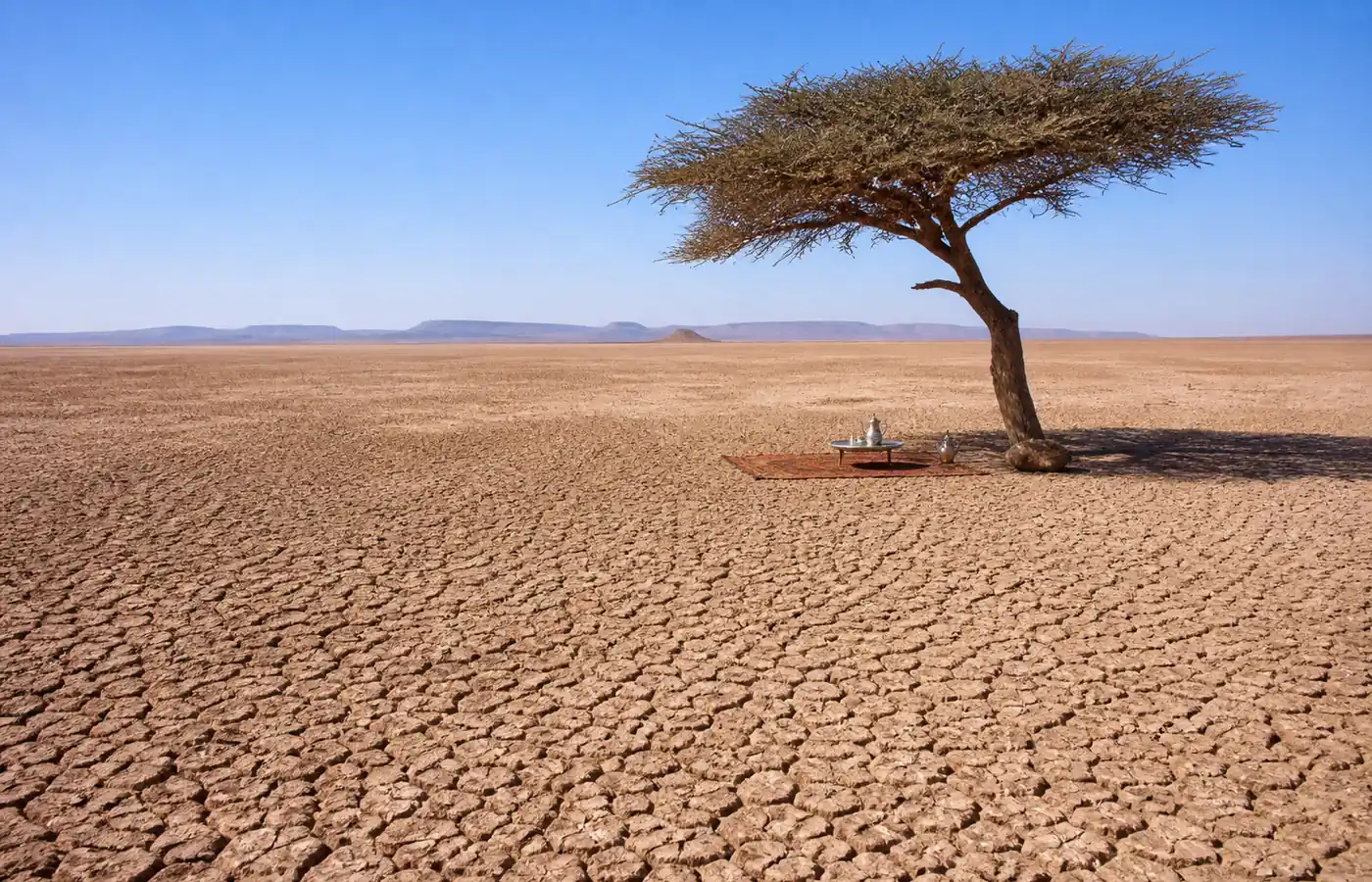
- Dawn: at sunrise, summer air over the dry lakebed has a sharpness that winter mornings lack.
- Flexibility: you can book in the evening for the next morning, with us as anywhere else, and seats are easy to find.
Summer is therefore not a poor copy of winter. It is a different format: shorter, built around the morning, and often calmer.
A sample day in July or August
- 5:30 a.m., departure. Off to the lake on the summer version of the Lake Iriqui day trip: the lakebed under low, slanting light, then the Moroccan Colorado.
- 11 a.m., return. The 4x4 is back in the village before the burning hours.
- Noon to 5 p.m., shade. Lunch, a siesta, or a stroll through the Foum Zguid palm grove, where the fronds keep some freshness in the air.
- Evening, the village. As the light fades, people fill the terraces. In summer you live the desert by day and talk it over at night.
Swimming variant: swap the afternoon for Tissint, one hour's drive away. Waterfalls and natural pools this deep in the Sahara surprise most visitors. Where to find them, and the way to the Attiq falls, are set out in our Tissint guide.
Flexible dates? Aim for September
- What changes: in the first fortnight of September, nights drop to 20-24 °C.
- The camp: our desert camp opens again, and sleeping in the dunes is back on the menu.
- The mood: the dunes stay nearly as empty as in August.
- Our advice: if your trip can move by a week or two, move it towards September.
The other seasons, month by month, are compared on our page about the best season for the Sahara.
Questions and answers
Why do some agencies still offer a night in the dunes in August?
Because travellers ask for it, and a refusal loses the sale. Our family chose the other way. In August the nights stay between 26 and 30 °C: inside a tent the air does not move, and nobody sleeps. Our camp season runs from September to early June, so July and August are closed. In high summer, the desert is a sunrise outing, not a night out.
Can you really bear a sunrise trip in July?
Yes, provided the timing holds. Around 6 a.m. it is 26 to 30 °C on Lake Iriqui, the light is superb and nobody else is there. You drive back before the heat goes past 40 °C. After 11 a.m. you stop: by midday the thermometer can hit 47 °C in the shade, and out on the lakebed there is none.
Can you swim at Tissint during the summer?
Yes, and summer is the best season for it. The Tissint waterfalls and pools lie roughly one hour from Foum Zguid, along 67 km of tarmac. Two caveats: the water is salty, and how much of it there is depends on that year's rain. Write to us before setting off and we will tell you how the site looks. Tissint pairs well with the early morning on the lake.